WHAT IS CONCRETE????
Concrete is a mixture of cement,aggregates and water together with any other admixtures which may be added to modify the placing and curing processes or the ultimate physical properties.The cement and water hardened by a chemical process,called hydration.Initially,when mixed concrete is a plastic material,which take the shape of the mould or formwork.When hardened it may be a dense,load-bearing material or a lightweight,thermally insulating material,depending largely on the aggregates used.It may be reinforced or prestressed by the incorporation of steel.
Most concrete is crushed and recycled at the end of its useful life,frequently as hard core for new construction work.However,a growth in the use of recycled aggregates for new concrete can be anticipated,as this will have a significant environment gain in reducing the demand on new aggregates extraction.
Concrete have the good workability when it is fresh.It also have the high strength and hardness when we mixed the concrete very well,and make sure there are no any moisture inside the concrete.Its strength can be tested by carry the compressing test and the load test.The hardeness is refer to the ability of the concrete to resist the heavy load.Lastly,concrete have the adequate durability which can stand for a many years.
Most structure have the concrete as their main building material,used in one of the following form:


Prestressed concrete
Most structure have the concrete as their main building material,used in one of the following form:
- reinforced concrete
- prestressed concrete
- mass concrete
REINFORCED CONCRETE
- mixture of coarse aggregate(stone&brick),fine aggregate(sand&crushed stone) and binder material(portland cement)
- strong in compression
- crushing range is in the range 20-40MPa
- concrete which is have the reinforced bar to strengthen the concrete in tension
- durability in concrete environment
- thermal compactibility
- high strength
- can encompass into many types of structure,eg:slab,beam,column
Prestressed concrete
- also named as precast concrete
- overcome the problem of tension on concrete based on great strength
- eliminate tensile stress on the concrete will reduce cracks on it.
- suitable to produce beam, bridge
- good quality control
The photo below show the different between reinforced concrete and prestressed concrete:


The photo below show the different between reinforced concrete and prestressed concrete:
Mass concrete
- defined as any volume of concrete with dimensions large enough to require that measures be taken to cope with generation of heat from hydration of the cement and attendant volume change to minimize cracking. ( American Concrete Institute (ACI) )
- invented due to its durability, strength ,thermal action and also economic.
The video below simply show that how concrete are been mixing in construction site:
DEFECTS IN CONCRETE
1)Colour Variation
- Difference in colour across the surface of concrete . May appear as patches of light and dark .
- Cause by uneven or variables curing conditions .
- Prevention : Use an even concrete mix when placing , compacting and finishing and keep concrete evenly moist. Do not use driers .
2)Crazing

- A network of fine cracks across the surface of concrete .
- Causes Crazing is caused by minor surface shrinkage in rapid drying condition . (ie low humidity and hot temperature )
- Prevention : Finish and cure concrete correctly .
3)Spalling

- When the slab edges and joints chip or break leaving an elongated cavity .
- Causes Edges of joints break because of heavy load or impact with hard objects . As concrete expands and contracts the weak edges may crack and break .
- Prevention Design the joints carefully . Keep joints free from rubbish . Keep heavy loads away from the joints and edges until they have properly hardened .
4) Efflorescence

- A white crystalline deposit sometimes found on the surface of concrete soon after it is finish .
- Causes Sometimes mineral salts are dissolved in water . If water with dissolved mineral salts collect on the concrete surface as water evaporate salts deposits are left on the surface .
- Prevention Use clean , salt free water and washes sand .
5)Honeycombing
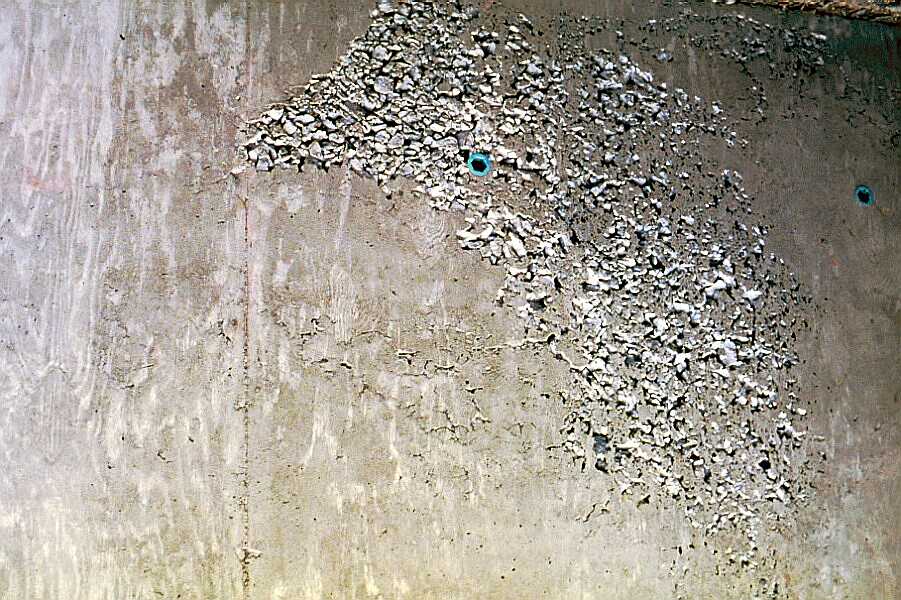
- When too much coarse aggregate appears on the surface .
- Causes Poor compaction , segregation during placing or place leakage from forms .A poor concrete mix with not enough fine aggregate causing a rocky mix .
- Prevention Use a better mix design . Take care during placing concrete to avoid segregation . Compact concrete properly . Good watertight formwork .

-This will results in 3 main different types of shape:

2)Compacting factor test
-ratio of weight partially compact concrete to weight of fully
compact concrete

-video about process of compacting factor test:
