-usually used in construction of walls.
-also known as concrete masonry unit(CMU)
-contain one or more cavity
-larger size than bricks
-intended to be plastered
-mixture of cement,water,sand and gravel that will produce
light gray block with fine surface texture&high compressive
strength
-classified into 2 types of blocks:clay blocks
:concrete blocks
CLAY BLOCKS
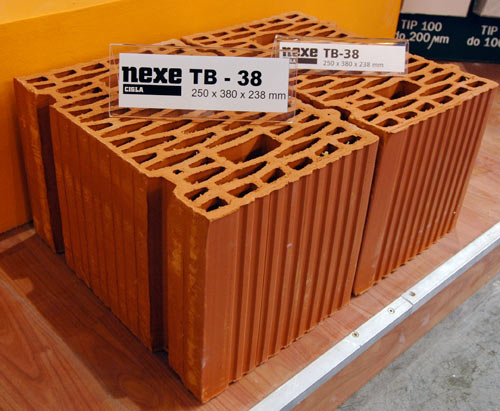
Clay blockconstruction is an extremely versatile and efficient way to build. Its excellent energy saving characteristics combined with the build quality and speed will outperform most other traditional aggregate blocks. The benefits are such that building with clay blocks has become the foremost method of construction in many European countries. Utilised on many commercial and domestic projects, clay blocks are suitable for single and multi storey applications.
Modern clay blocks are precision engineered walling units designed to be thermally and acoustically efficient. During manufacture clay is prepared with sand, straw or recycled materials, extruded, dried and fired. The addition of these other materials helps enhance their unique properties as they are burned off during firing leaving behind innumerable small holes and connecting pores. The air trapped within these pores helps retain heat and reduce sound transmission. After firing the blocks are precision ground within +/- 0.5mm allowing for the construction of highly accurate and precise walls.
A clay block does not rust or warp and is resistant to fire and attack from insects. They require very little immediate or on-going maintenance and lend themselves to an array of final surface finishes. Although facing bricks or a modern wall cladding system are options, traditionally clay blocks are best finished with lime render to allow the building to 'breathe'.
Although on first appearance the price of each unit can be a little higher than other construction methods, when costs for materials and laying are taken into account clay blocks become an attractive, cost effective and realistic alternative to traditional brick and block cavity walls. In some cases using a clay block construction system can also help increase the overall value of the project in question.
Clay block construction projects are highly eco-friendly. The blocks themselves have less environmental impact during their manufacture than most other building materials, and the finished building offers very high insulation values.
(information from http://www.porothermuk.co.uk/clay-block.cfm)
-needed in the production of redbrick,clay pot,bowl, pink vase
CONCRETE BLOCKS

-is further classified as lightweight and dense blocks
-ratio of lightweight concrete block to dense block is 1:3
-density of lightweight concrete block(1800-2100kg/m*3)
-density for dense block(850-1500kg/m*3)
-lightweight concrete block made by
(a) replace sand &gravel to expanded clay,shale or slate
(b)crush it and heat 1093degree Celsius
----->used to build non-bearing walls or partitions
-Types of concrete block:
 *no any holes
 with holes which dont pass through
 with cavities which can pass through
Click the link for further information of concrete block--->Concrete block size and shape
a)English bond-a masonry bond that courses alternatively of short side of the brick(headers) and long side of brick(stretchers) both facing outwards

b)Flemish bond-alternative bricks are placed as header&stretches in every course.Each header placed centrally between the stretcher immediately.

c)English garden wall bond-an alternative version of english bond with header courses being inserted at every fourth or sixth course.

d)Flemish garden wall bond-used in solid walls which required to be fair faced both sides.

e)Heading bond-bricks with ends showing on the face of the walls.laid with a half lap of the brick
f)Running(stretcher bond)-originally used for single brick walls, now it also called 1/2 brick walls. It became the obvious choice for cavity walls as less cutting needed.

g)Raking bond-herringbone and diagonal bonds can be effective within an exposed framed construction, contained within restraining brick courses.

Beam And Block Flooring
Beam and Block flooring is the traditional and cost effective suspended flooring system for ground and upper floor . It is also a quick and easy solution to flooring and a viable alternative to timber floors .


Advantage of using beam and block flooring system is :
- Fast and simple installation requiring no special skills
- Maintenance-free
- High level of thermal and sound insulation and fire resistance
- Allow longer span than timber joists
- Safe working platform - As soon as the flooring is installed the floor can safely be used as a working platform , allowing the inner leaf construction work to commence
Below is a video which demonstrate the Beam and block floor system which is very good at thermal insulation
Other type of beam and block construction detail example
1) Internal edge detail

2)Staggered bearing on an internal wall

3)Multiple beam supporting partition

4)External wall bearing

5) Transverse Stagger

Below is the section view of these type of beam and block detail :

